 Add to Chrome
 Add to Firefox
 Add to Edge
Towards 3D heart mesh generation using contactless radar imaging and physics-informed neural network
May 25, 2026
Cardiac function evaluation necessitates continuous, non-invasive monitoring, a capability limited in MRI. Millimeter-wave (mmWave) radar and its Synthetic Aperture Radar (SAR) mode offer a privacy-preserving and portable point-of-care clinical applications. However, reconstructing high-fidelity 3D cardiac geometry from SAR remains an open challenge. Traditional radar methods generate sparse point clouds that lack continuous surface topology. Meanwhile, direct application of optical reconstruction networks performs poorly due to the severe speckle noise and ambiguous boundaries inherent in SAR images. To bridge this gap, we propose SAR2Mesh, a novel framework that reformulates the task as a coarse-to-fine mesh deformation process. By initializing with a topological template, our approach explicitly preserves anatomical connectivity through progressive mesh deformation.We introduce a geometry-aware feature projection module to extract multi-view features via 3D-to-2D sampling, and a physics-informed radar loss to enforce consistency between the predicted geometry and raw radar echoes. Furthermore, we present Cardiac Mesh-SAR, the first large-scale paired SAR-mesh dataset. Extensive experiments demonstrate that SAR2Mesh significantly outperforms existing image-based baselines, achieving accurate and physically consistent cardiac reconstructions.

How Far Has AI Come in Liver Fibrosis Staging? A Large-Scale Real-World Dataset and Benchmark
May 25, 2026Despite years of methodological progress, how far AI has come in liver fibrosis staging has never been systematically evaluated under the heterogeneous, multi-center conditions that define clinical practice. To address this gap, we introduce LiFS, a large-scale dataset and benchmark derived from the MICCAI 2025 CARE-Liver challenge, comprising 610 patients across multiple centers and scanners with multi-sequence MRI. To the best of our knowledge, LiFS is the first benchmark providing complete gadoxetic acid-enhanced sequences with histopathology-confirmed annotations from diverse real-world scanners. Through systematic evaluation of 9 independently developed methods selected from 96 registered teams against in-cohort radiologist reference results, our findings address how far current AI has progressed toward clinical-level liver fibrosis staging from three complementary perspectives. First, against radiologists, the best AI methods were broadly comparable to the senior radiologist and significantly exceeded the junior radiologist in selected settings, while median AI performance generally approached junior-radiologist levels. Second, from a data perspective, cross-center heterogeneity, label imbalance, and contrast-enhanced sequence variability emerge as the dominant challenges for AI methods. Third, from a technical perspective, methodological design choices, including spatial registration, input dimensionality, multi-modal fusion strategy, and backbone architecture, appear to modulate cross-center robustness, although no single choice alone closes the gap. Overall, LiFS provides a rigorous real-world benchmark for positioning the current state of AI in liver fibrosis staging and for enabling future research on the key challenges that limit clinically reliable deployment.
Generalized Evidential Deep Learning: From a Bayesian Perspective
May 25, 2026Evidential Deep Learning (EDL) has emerged as an efficient, sampling-free strategy for uncertainty estimation. A series of EDL variants have been proposed to address specific limitations of the original framework, achieving notable success. However, the underlying theoretical structure of EDL and the relationships among these variants have received limited systematic investigation. In this work, we establish a principled theoretical foundation for EDL by interpreting it within a generalized Bayesian framework that includes prior specification, posterior update, and training objective. We further characterize evidential uncertainty from a Bayesian distributional uncertainty viewpoint, established via asymptotic analysis. Building on this perspective, we further propose Generalized Evidential Deep Learning (GEDL), a unified and extensible framework that explicitly disentangles the roles of individual components and systematically relates GEDL to existing variants. Extensive experiments demonstrate that GEDL yields comparable results on classification, uncertainty estimation and OOD detections, with theoretical grounding.
X-Edit: Exact, Explicit, and Explainable Null-Space Editing for Medical Vision Transformers
May 24, 2026Pre-trained Vision Transformers (ViTs) are increasingly deployed for medical image classification. However, correcting their inevitable failure cases in dynamic clinical scenarios poses a critical challenge. Conventional fine-tuning approaches inherently suffer from catastrophic forgetting, severely degrading previously acquired diagnostic capabilities. Such instability fundamentally compromises clinical safety. Addressing this vulnerability requires an active, controllable, and reliable intervention mechanism that is both theoretically grounded and inherently interpretable. To this end, we propose X-Edit (eXact, eXplicit, and eXplainable Editing), an efficient null-space model editing framework. X-Edit transitions the editing process from iterative gradient-based optimization to a theoretically grounded, closed-form solution. Specifically, we first explicitly localize the influential layers via causal tracing governing the erroneous prediction. Subsequently, we construct an orthogonal null-space projection matrix from a curated anchor set. By geometrically constraining the exact parameter update strictly within this null space, we provide mathematical guarantees that the intervention rectifies targeted errors without perturbing established diagnostic representations. Extensive evaluations on six medical imaging benchmarks demonstrate that X-Edit comprehensively suppresses catastrophic forgetting while achieving superior edit success rates. Our code is available at https://github.com/HenryLau7/X-Edit.
ZScribbleSeg: A comprehensive segmentation framework with modeling of efficient annotation and maximization of scribble supervision
May 07, 2026Curating fully annotated datasets for medical image segmentation is labour-intensive and expertise-demanding. To alleviate this problem, prior studies have explored scribble annotations for weakly supervised segmentation. Existing solutions mainly compute losses on annotated areas and generate pseudo labels by propagating annotations to adjacent regions. However, these methods often suffer from inaccurate and unrealistic segmentations due to insufficient supervision and incomplete shape information. In contrast, we first investigate the principle of good scribble annotations, which leads to efficient scribble forms via supervision maximization and randomness simulation. We further introduce regularization terms to encode the spatial relationship and the shape constraints, where the EM algorithm is utilized to estimate the mixture ratios of label classes. These ratios are critical in identifying the unlabeled pixels for each class and correcting erroneous predictions, thus the accurate estimation lays the foundation for the incorporation of spatial prior. Finally, we integrate the efficient scribble supervision with the prior into a framework, referred to as ZScribbleSeg, and apply it to multiple scenarios. Leveraging only scribble annotations, ZScribbleSeg achieves competitive performance on six segmentation tasks including ACDC, MSCMRseg, BTCV, MyoPS, Decathlon-BrainTumor and Decathlon-Prostate. Our code will be released via https://github.com/DLwbm123/ZScribbleSeg.
Beyond Forgetting in Continual Medical Image Segmentation: A Comprehensive Benchmark Study
May 07, 2026Continual learning (CL) is essential for deploying medical image segmentation models in clinical environments where imaging domains, anatomical targets, and diagnostic tasks evolve over time. However, continual segmentation still faces three main challenges. First, the scenarios for this task remain insufficiently standardized for real-world clinical settings. Second, existing research has been primarily focused on mitigating forgetting, overlooking the other essential properties such as plasticity. Third, a benchmark work with comprehensive evaluation on existing methods is stll desirable. To address these gaps, we present such benchmark study of continual medical image segmentation. We first define three clinically motivated scenarios, namely Domain-CL, Class-CL, and Organ-CL, to respectively capture the cross-center domain shift, the incremental anatomical structure segmentation, and the cross-organ segmentation. We then introduce an evaluation framework that measures not only general performance and forgetting, but also plasticity, forward generalizability, parameter efficiency, and replay burden. The results, from extensive experiments with representative CL methods, showed that it was still challenging to develop a model that could satisfy all the requirements simultaneously. Nevertheless, these studies also suggested that the replay-based methods achieve the best overall balance between stability and plasticity, the parameter-isolation methods should be effective at reducing forgetting, though at the cost of increased model size, and the forward generalizability remain a significantly understudied aspect of this research field. Finally, we discuss related learning paradigms and outline future directions for continual medical image segmentation.
Open World MRI Reconstruction with Bias-Calibrated Adaptation
Mar 13, 2026Real-world MRI reconstruction systems face the open-world challenge: test data from unseen imaging centers, anatomical structures, or acquisition protocols can differ drastically from training data, causing severe performance degradation. Existing methods struggle with this challenge. To address this, we propose BiasRecon, a bias-calibrated adaptation framework grounded in the minimal intervention principle: preserve what transfers, calibrate what does not. Concretely, BiasRecon formulates open-world adaptation as an alternating optimization framework that jointly optimizes three components: (1) frequency-guided prior calibration that introduces layer-wise calibration variables to selectively modulate frequency-specific features of the pre-trained score network via self-supervised k-space signals, (2) score-based denoising that leverages the calibrated generative prior for high-fidelity image reconstruction, and (3) adaptive regularization that employs Stein's Unbiased Risk Estimator to dynamically balance the prior-measurement trade-off, matching test-time noise characteristics without requiring ground truth. By intervening minimally and precisely through this alternating scheme, BiasRecon achieves robust adaptation with fewer than 100 tunable parameters. Extensive experiments across four datasets demonstrate state-of-the-art performance on open-world reconstruction tasks.
Few-Shot Video Object Segmentation in X-Ray Angiography Using Local Matching and Spatio-Temporal Consistency Loss
Jan 02, 2026We introduce a novel FSVOS model that employs a local matching strategy to restrict the search space to the most relevant neighboring pixels. Rather than relying on inefficient standard im2col-like implementations (e.g., spatial convolutions, depthwise convolutions and feature-shifting mechanisms) or hardware-specific CUDA kernels (e.g., deformable and neighborhood attention), which often suffer from limited portability across non-CUDA devices, we reorganize the local sampling process through a direction-based sampling perspective. Specifically, we implement a non-parametric sampling mechanism that enables dynamically varying sampling regions. This approach provides the flexibility to adapt to diverse spatial structures without the computational costs of parametric layers and the need for model retraining. To further enhance feature coherence across frames, we design a supervised spatio-temporal contrastive learning scheme that enforces consistency in feature representations. In addition, we introduce a publicly available benchmark dataset for multi-object segmentation in X-ray angiography videos (MOSXAV), featuring detailed, manually labeled segmentation ground truth. Extensive experiments on the CADICA, XACV, and MOSXAV datasets show that our proposed FSVOS method outperforms current state-of-the-art video segmentation methods in terms of segmentation accuracy and generalization capability (i.e., seen and unseen categories). This work offers enhanced flexibility and potential for a wide range of clinical applications.
Liver Fibrosis Quantification and Analysis: The LiQA Dataset and Baseline Method
Dec 22, 2025Liver fibrosis represents a significant global health burden, necessitating accurate staging for effective clinical management. This report introduces the LiQA (Liver Fibrosis Quantification and Analysis) dataset, established as part of the CARE 2024 challenge. Comprising $440$ patients with multi-phase, multi-center MRI scans, the dataset is curated to benchmark algorithms for Liver Segmentation (LiSeg) and Liver Fibrosis Staging (LiFS) under complex real-world conditions, including domain shifts, missing modalities, and spatial misalignment. We further describe the challenge's top-performing methodology, which integrates a semi-supervised learning framework with external data for robust segmentation, and utilizes a multi-view consensus approach with Class Activation Map (CAM)-based regularization for staging. Evaluation of this baseline demonstrates that leveraging multi-source data and anatomical constraints significantly enhances model robustness in clinical settings.
CineMyoPS: Segmenting Myocardial Pathologies from Cine Cardiac MR
Jul 03, 2025
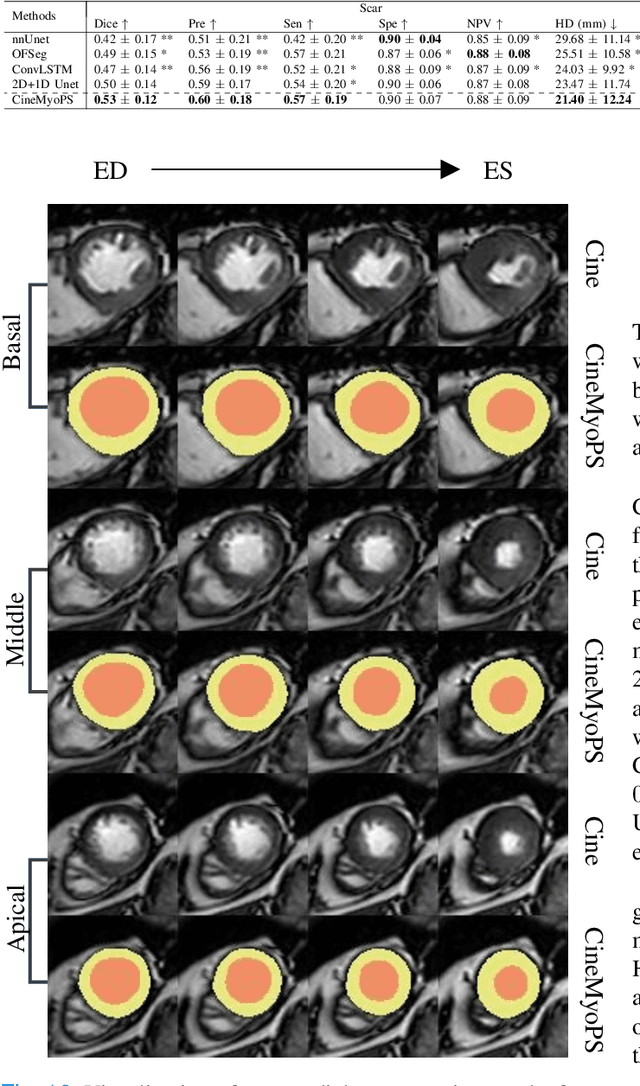
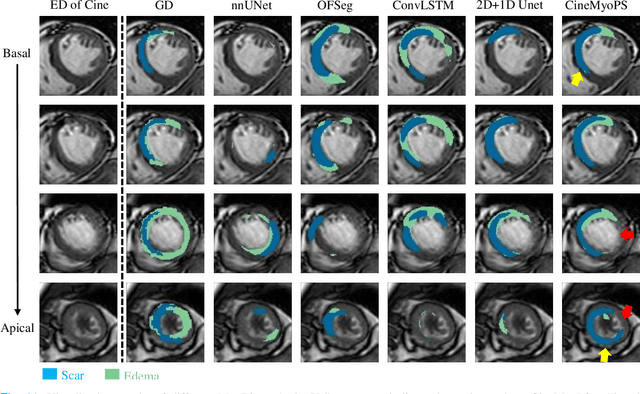
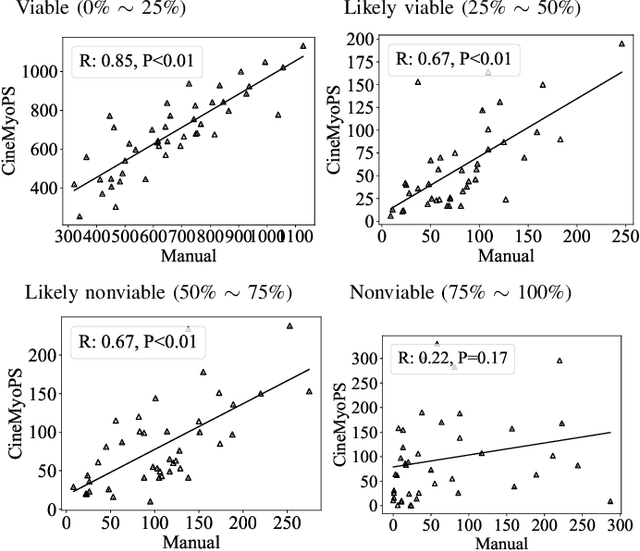
Myocardial infarction (MI) is a leading cause of death worldwide. Late gadolinium enhancement (LGE) and T2-weighted cardiac magnetic resonance (CMR) imaging can respectively identify scarring and edema areas, both of which are essential for MI risk stratification and prognosis assessment. Although combining complementary information from multi-sequence CMR is useful, acquiring these sequences can be time-consuming and prohibitive, e.g., due to the administration of contrast agents. Cine CMR is a rapid and contrast-free imaging technique that can visualize both motion and structural abnormalities of the myocardium induced by acute MI. Therefore, we present a new end-to-end deep neural network, referred to as CineMyoPS, to segment myocardial pathologies, \ie scars and edema, solely from cine CMR images. Specifically, CineMyoPS extracts both motion and anatomy features associated with MI. Given the interdependence between these features, we design a consistency loss (resembling the co-training strategy) to facilitate their joint learning. Furthermore, we propose a time-series aggregation strategy to integrate MI-related features across the cardiac cycle, thereby enhancing segmentation accuracy for myocardial pathologies. Experimental results on a multi-center dataset demonstrate that CineMyoPS achieves promising performance in myocardial pathology segmentation, motion estimation, and anatomy segmentation.